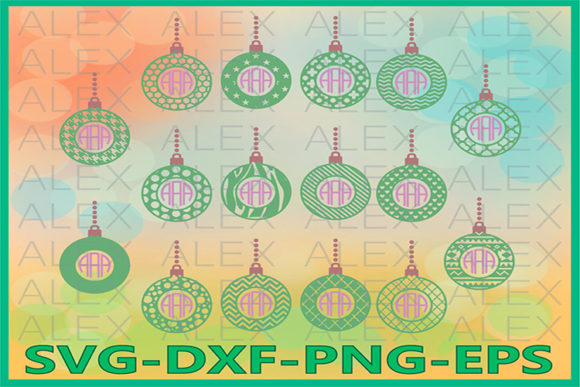
Christmas Balls Monogram: A Designer’s Stitch Test
When evaluating digital assets for physical production, there is often a disconnect between how a graphic looks on screen and how it translates through a needle and thread. As a designer who regularly bridges the gap between digital illustrations and tangible handmade products, I approached the Christmas Balls Monogram with a critical eye. This collection includes 16 files in SVG, DXF, EPS, AI, and PNG formats, packed in a zip archive. While the product description highlights its utility for decals and wall decoration, my primary interest was determining its viability as a machine embroidery design for commercial and personal projects.
First Impressions and Visual Personality
Upon unpacking the zip archive and reviewing the vector files, the immediate strength of this collection is its balanced composition. The Christmas Balls Monogram carries a nostalgic yet clean aesthetic that avoids looking overly cluttered. For an embroidery project, negative space is just as important as the stitched areas, and these graphics respect that boundary. The mood is festive without being chaotic, making it suitable for both traditional holiday embroidery and modern boutique merchandise.
As a set of illustrations, the lines are distinct. However, because these are marketed as graphics rather than pre-digitized embroidery files, they serve as excellent templates for custom digitizing or vinyl cutting. For those using them as a base for machine embroidery, the shapes appear conducive to satin stitch borders and fill stitch interiors. The visual weight suggests they would hold up well on medium-weight fabrics, providing enough presence to be recognized from a distance without overwhelming delicate materials.
Real-World Application: The Custom Sweatshirt Test
To truly judge the utility of this design, I mentally mapped it onto a current client request: a personalized holiday sweatshirt for a small shop product line. In this scenario, the Christmas Balls Monogram needs to function as more than just decoration; it must act as a focal point that drives buyer engagement.
For a sweatshirt embroidery application, typically placed on the left chest or centered on the back, the design’s scalability is crucial. Because the source files include vectors like EPS and AI, resizing for different garment sizes—from youth small to adult 3XL—should maintain crisp edges. When stitching this onto fleece or French terry, I envision using a combination of running stitch outlines to define the ornament shape and lighter density fill stitches to prevent fabric distortion. The monogram element allows for high-value personalization, transforming a generic holiday graphic into a meaningful personalized gift. Customers are far more likely to purchase custom apparel when they see their name or initials integrated seamlessly into the artwork.
Navigating Fabric Textures and Stabilizer Choices
While the Christmas Balls Monogram is versatile, its performance relies heavily on proper preparation. Graphics designed for print do not always account for fabric texture. If you plan to use this for tea towels or linen napkins, the weave of the fabric can compete with finer details in the illustration. In such cases, I recommend testing the design on scrap fabric first. You may need to adjust the stitch density or add an underlay to ensure the monogram remains legible against textured backgrounds.
Stabilizer selection is non-negotiable here. For stretchy fabrics like jersey knits used in baby embroidery or t-shirts, a cut-away stabilizer is essential to prevent puckering around the curved edges of the ball shapes. Conversely, if you are creating an embroidered patch or working with canvas tote bags, a tear-away or heavy-duty cut-away might be appropriate depending on the final desired drape. Always confirm your hoop size before committing to a layout; while the vectors are scalable, intricate corners in the monogram lettering may require a minimum stitch length to avoid thread breaks or bird nesting.
Commercial Viability for Etsy Sellers and Makers
For creative entrepreneurs and Etsy sellers, time is money. The value of this 16-file pack lies in its variety. Having multiple variations allows for brand consistency across different product categories without repetitive design work. You could use one variation for a nursery decor pillow cover and another for a matching baby bib, creating a cohesive collection that encourages bundled sales.
The inclusion of PNG files is particularly useful for creating printable mockups. Before you even thread a needle, you can overlay these graphics onto digital product previews to gauge customer interest. This reduces waste and helps validate which variations of the Christmas Balls Monogram resonate most with your audience. However, a word of caution for digital product sellers: always verify the licensing terms included in the archive. Ensure you have the rights to sell finished physical items versus selling the digital embroidery file itself, as these permissions often differ.
Critical Considerations for Small Details and Washability
A beautiful screen image does not guarantee a durable finished product. When adapting the Christmas Balls Monogram for items that require frequent washing, such as kitchen towels or baby clothes, detail retention is key. Thin serif fonts or delicate filigree within the monogram may degrade over time if stitched too small. I advise against reducing the design below a certain threshold where satin stitches become narrower than 1mm. If the detail is too fine, consider simplifying the vector nodes before digitizing or opting for a bolder version from the 16-file set.
Thread color contrast also plays a massive role in visual clarity. A white monogram on a cream fabric might look elegant on screen but disappear in real life. Test your thread colors against the actual fabric swatch, not just a digital rendering. For dark fabrics, ensure the design has adequate underlay to prevent the fabric grain from showing through light-colored threads. This attention to technical execution is what separates professional commercial embroidery from amateur hobbyist work.
Designer Notes for Successful Execution
Before launching this design into your holiday production queue, run through this practical checklist to ensure professional results:
- Verify File Integrity: Unpack the zip archive completely and organize the SVG, DXF, EPS, AI, and PNG files into folders by project type to streamline your workflow.
- Test Stitch-Outs: Never skip the test run. Use the exact fabric and stabilizer combination intended for the final product to check for registration issues or density problems.
- Check Licensing: Confirm whether the license permits commercial use for both physical goods and digital assets before listing any item in your shop.
- Evaluate Complexity: If digitizing from scratch, assess whether the illustration requires simplification for embroidery. Not every vector line translates to a stitch path.
- Mockup Validation: Use the provided PNGs to create realistic listings. Accurate representation builds customer trust and reduces return rates due to unmet expectations.
- Hoop Planning: Select the smallest hoop size that comfortably fits the design to maximize tension stability, especially for curved surfaces like caps or sleeves.
Final Verdict on Versatility
The Christmas Balls Monogram offers a strong foundation for holiday-themed creation, provided the user understands the distinction between a graphic illustration and a ready-to-stitch embroidery file. Its true power is unlocked when treated as a premium template for customization. Whether you are crafting a bespoke holiday gift, expanding your small shop product line, or designing decals for seasonal decor, these assets provide the necessary flexibility. By applying professional embroidery standards regarding density, stabilization, and fabric compatibility, makers can transform these digital vectors into high-quality, profitable physical goods that stand out in a crowded marketplace.